

The Old Man and the Sea, the dignity of continuing to row when the world sleeps. [EN/ES]
2 comments

Hello, friends of HiveBook Club. We begin a new year, and if December was a torch to close cycles, January is an open sea to try again. That’s why I wanted to bring today a novel that speaks precisely about that, about persisting when everyone doubts, about holding on to a purpose even when the body weighs and the silence deafens. The Old Man and the Sea, by the American Ernest Hemingway, was born in 1952, but its heart beats in Cuba, in the saltpeter of the Caribbean and in the will of a man named Santiago.
The story told in a simple way, but huge to feel, Santiago is an old fisherman, marked by 84 days without catching a fish. The bad streak turns him into a rumor of the town, into pity for some, into mockery for others. Only the young Manolín, his friend and apprentice, continues to believe in him with a faith that needs no speeches. Then Santiago decides to go alone into the Gulf, without knowing that the sea would not give him a victory, but a test of character.
And there appears the marlin, the great fish that becomes adversary, brother, and mirror. For three days, the old man fights against the creature and against his own exhaustion. When he finally catches it, the sharks arrive, the loss, the certainty that winning does not always mean bringing everything back home. But also the most important revelation, the value is not in the result, but in the endurance with which the attempt is faced.
As always I share here a sentence that summarizes that philosophy with an almost sacred strength, and that I would like to share with you in its original language, which is English it was published for the first time in 1952 in Life magazine. Being published that same year in book format by Charles Scribner’s Sons, also in English. The sentence is the following:
“But man is not made for defeat. A man can be destroyed but not defeated.”
Ernest Hemingway, The Old Man and the Sea, 1952»
Paraphrasing Hemingway:
A man can lose everything, even return with empty hands, but true endurance is a victory that no storm can sink.
That line is pure backbone of the book. It is not naive optimism, it is a declaration of dignity. Santiago loses the fish in pieces, but returns whole in essence. He loses the trophy, but not the victory, because there are victories that don’t weigh on the net, but on the gaze.

The novel was translated into more than 30 languages, which allowed its message of resilience and dignity to reach readers across the world
Hemingway knew Cuba well. He lived for years in Finca Vigía, near Havana, where he wrote this novel.
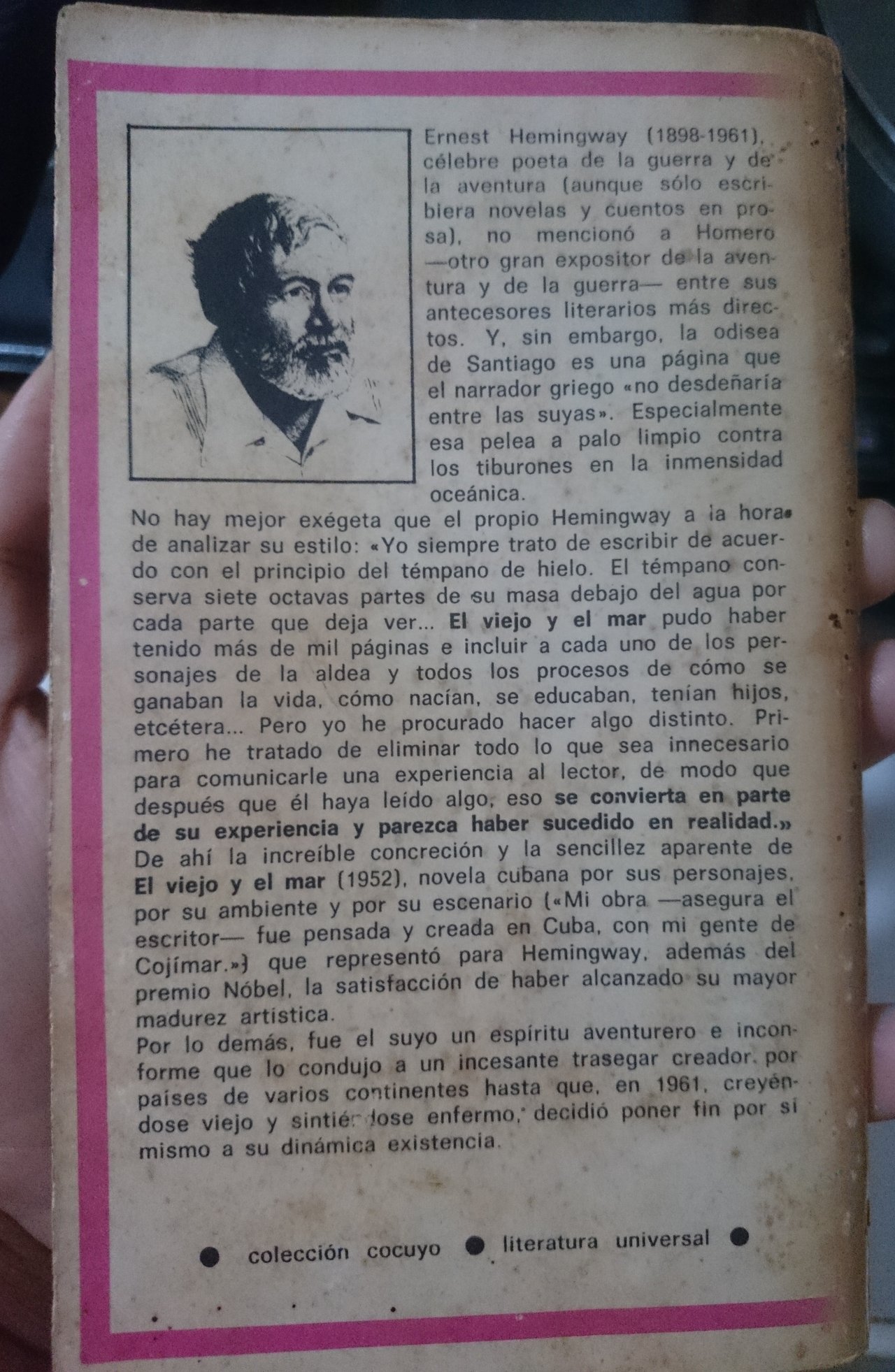
As he himself said, Cuban novel for its characters, for its environment, and for its setting. He assured it was thought and created in Cuba with its people of Cojimar.
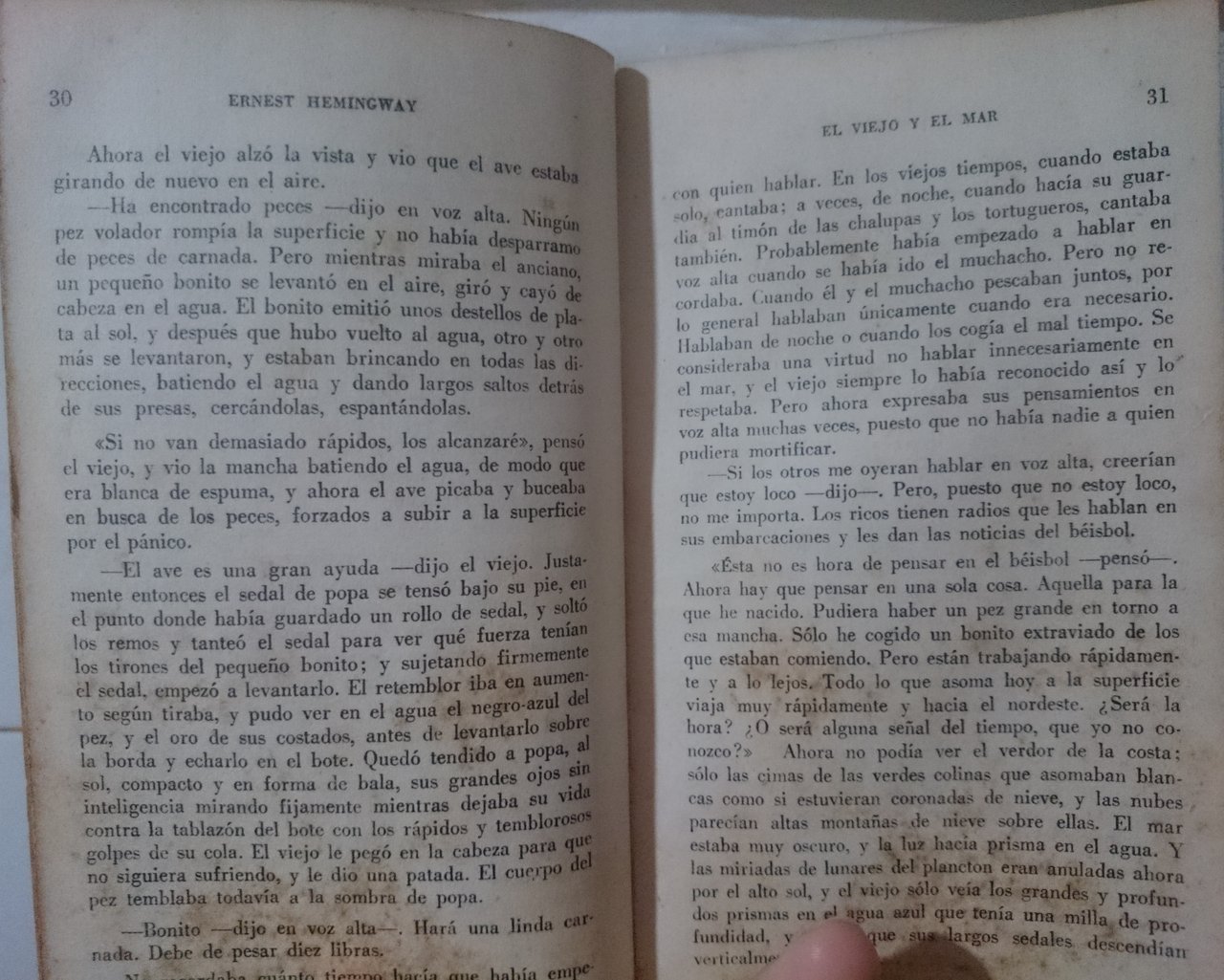
He said that the sea should be narrated with respect, as if it had memory of its own. And in the book it feels like that, it is not a stage, it is a character, it is challenge, language, destiny, mirror, temple and abyss.
He won the Pulitzer Prize with this work in 1953, and the following year the Nobel Prize in Literature, partly thanks to the universal resonance of this story. A curious fact, although it is his shortest and most direct novel, it is also one of the most symbolic. Hemingway considered it proof that he could say everything without excess, without ornament, like someone who speaks to the sea without raising his voice.
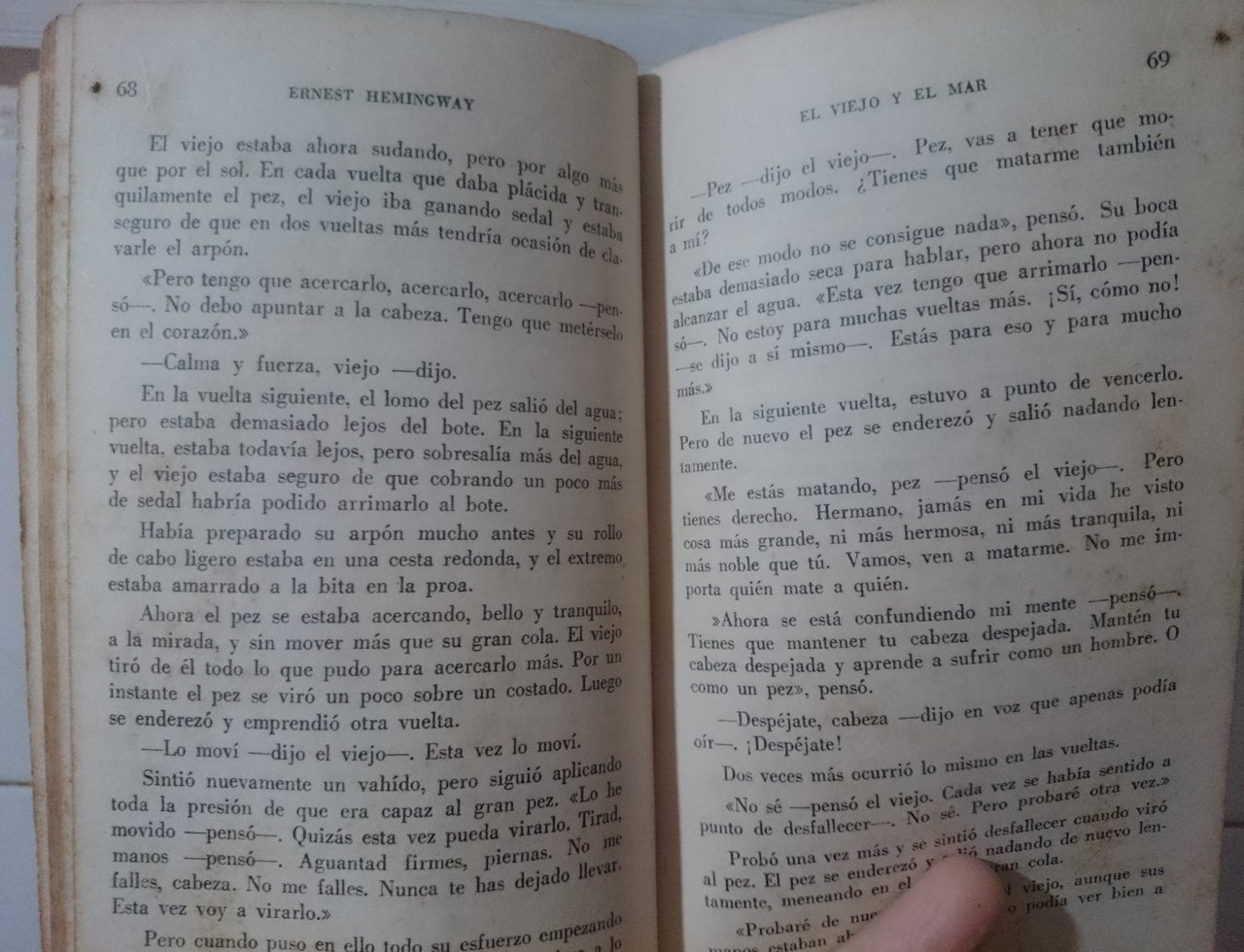
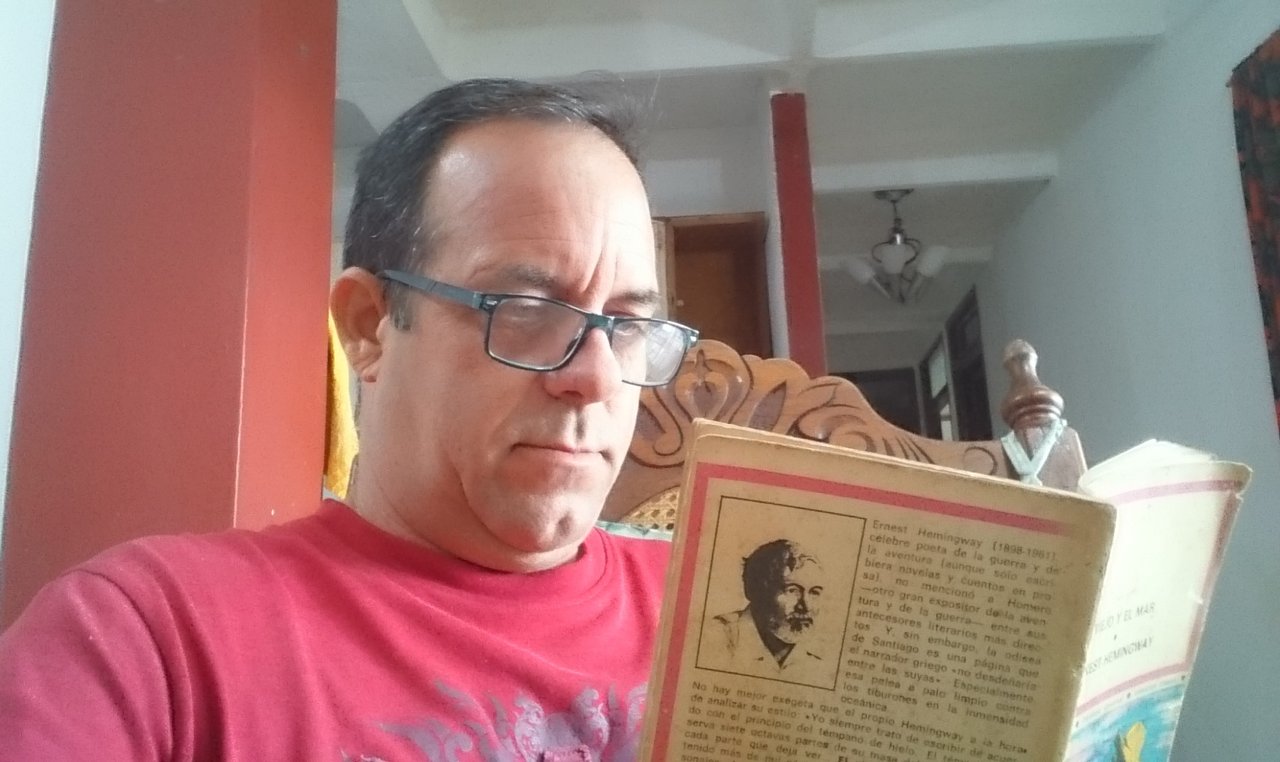
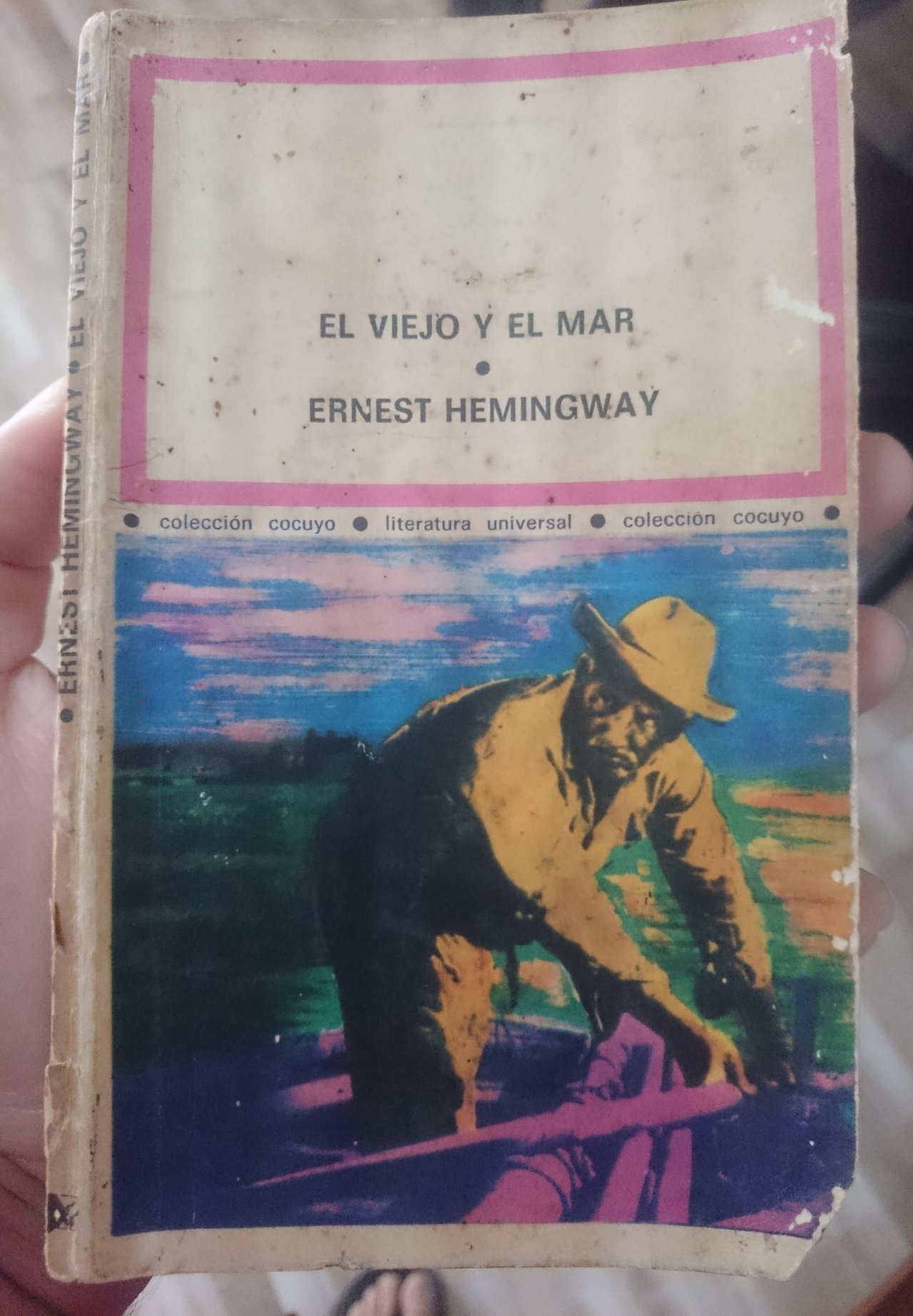
I share here the photos of my physical copy, it belongs to the edition made by the publishing house Arte y Literatura of Cuba in 1976. A paper book never fails, especially when electricity does. Mine is an edition that keeps the spirit of the classic and the aroma of time, a reminder that books don’t need batteries to save our night.
I would like to read you in the comments with this question the novel left me with, especially at the beginning of the year:
What has life (or a book) taught you about continuing to try even when there is no guarantee of victory?
Do you think Santiago would give up in the current scenarios?
Thank you for reading and for keeping alive this infinite conversation between books and human beings.
We start the year rowing together.
The images are my property taken with my mobile phone and for the English version I used Google Translator.
Spanish Version
El viejo y el mar, la dignidad de seguir remando cuando el mundo duerme
Hola, amigos de HiveBook Club. Comenzamos un nuevo año, y si diciembre fue antorcha para cerrar ciclos, enero es mar abierto para volver a intentarlo. Por eso quise traer hoy una novela que habla justamente de eso, de persistir cuando todos dudan, de sostener un propósito aunque el cuerpo pese y el silencio ensordezca. El viejo y el mar, del estadounidense Ernest Hemingway, nació en 1952, pero su corazón late en Cuba, en el salitre del Caribe y en la voluntad de un hombre llamado Santiago.
La historia contada de forma sencilla, pero enorme de sentir, Santiago es un pescador viejo, marcado por 84 días sin capturar un pez. La mala racha lo convierte en rumor del pueblo, en lástima para algunos, en burla para otros. Solo el joven Manolín, su amigo y aprendiz, sigue creyendo en él con una fe que no necesita discursos. Entonces Santiago decide adentrarse solo en el Golfo, sin saber que el mar no le regalará una victoria, sino una prueba de carácter.
Y ahí aparece el marlín, el gran pez que se convierte en adversario, hermano y espejo. Durante tres días, el viejo lucha contra la criatura y contra su propio desgaste. Cuando al fin logra capturarlo, llegan los tiburones, la pérdida, la certeza de que ganar no siempre significa traerlo todo de vuelta. Pero también la revelación más importante, el valor no está en el resultado, sino en la resistencia con que se enfrenta el intento.
Como siempre les comparto una frase que resume esa filosofía con una fuerza casi sagrada, y que quisiera compartir con ustedes en su idioma original, que es el inglés se publicó por primera vez en 1952 en la revista Life. Siendo publicada ese mismo año en formato de libro por Charles Scribner’s Sons, también en inglés. La frase es la siguiente:
“But man is not made for defeat. A man can be destroyed but not defeated.”
Ernest Hemingway, The Old Man and the Sea, 1952
En español seria así.
“Pero el hombre no está hecho para la derrota. Un hombre puede ser destruido, pero no derrotado.”
— Ernest Hemingway, El viejo y el mar, 1952
Parafraseando a Hemingway:
Un hombre puede perderlo todo, incluso volver con las manos vacías, pero la verdadera resistencia es una victoria que ninguna tormenta puede hundir.
Esa línea es pura columna vertebral del libro. No es optimismo ingenuo, es declaración de dignidad. Santiago pierde el pez en pedazos, pero regresa entero en esencia. Pierde el trofeo, pero no la victoria, porque hay victorias que no pesan en la red, sino en la mirada.
La novela fue traducida a más de 30 idiomas, lo que permitió que su mensaje de resiliencia y dignidad llegara a lectores de todo el mundo
Hemingway conoció bien a Cuba. Vivió por años en Finca Vigía, cerca de La Habana, donde escribió esta novela.
Como el mismo decía, novela cubana por sus personajes, por su ambiente y por su escenario. Aseguraba que fue pensada y creada en Cuba con su gente de Cojimar.
Decía que el mar debía narrarse con respeto, como si tuviera memoria propia. Y en el libro se siente, no es un escenario, es un personaje, es desafío, lenguaje, destino, espejo, templo y abismo.
Ganó el Premio Pulitzer con esta obra en 1953, y al año siguiente el Nobel de Literatura, en parte gracias a la resonancia universal de esta historia. Un dato curioso, aunque es su novela más breve y directa, también es una de las más simbólicas. Hemingway la consideraba la prueba de que podía decirlo todo sin exceso, sin adorno, como quien habla con el mar sin levantar la voz.
Les comparto aquí las fotos de mi ejemplar físico, corresponde a la edición hecha por la editorial Arte y Literatura de Cuba en 1976. Un libro en formato papel no falla sobre todo cuando la electricidad sí. El mío es una edición que guarda el espíritu del clásico y el aroma del tiempo, un recordatorio de que los libros no necesitan baterías para salvarnos la noche.
Quisiera leerlos en los comentarios con esta pregunta que me dejó la novela, especialmente en este inicio de año:
¿Qué te ha enseñado la vida (o un libro) sobre seguir intentándolo incluso cuando no hay garantía de victoria?
¿Crees que Santiago se rendiría en los escenarios actuales?
Gracias por leer y por mantener viva esta conversación infinita entre libros y seres humanos.
Comenzamos el año remando juntos.
Las imágenes son de mi propiedad hechas con el móvil y para la versión en inglés utilicé el traductor de Google.

Comments